Work Values Across Generations: Summary of Empirical Evidence
Popular media frequently claims that younger employees are less motivated, less loyal, and more narcissistic than older generations. This article evaluates whether those claims are actually supported by empirical evidence across multiple large datasets.
Date: 14. January 2026
Categories: PGarticle

A study by Twenge, Campbell, Hoffman, and Lance (2010) examines whether today’s younger workers (often labeled Generation Me or Millennials) differ from previous generations in work values, job attitudes, or personality traits relevant to work. Popular media frequently claims that younger employees are less motivated, less loyal, and more narcissistic than older generations. This article evaluates whether those claims are actually supported by empirical evidence across multiple large datasets.
The researchers used two major strategies:
-
Cross-temporal meta-analysis
-
Comparing scores on psychological scales across cohorts over time
-
Datasets spanned several decades
-
Measured constructs included:
-
work centrality
-
desire for leisure
-
intrinsic vs extrinsic values
-
job satisfaction
-
organizational commitment
-
self-esteem
-
narcissism
-
-
-
Nationally representative surveys of high school seniors
-
Especially Monitoring the Future surveys
-
Allowed comparison of adolescents from different graduating classes
-
Across these data sources, the researchers evaluated whether generation alone (cohort) explained meaningful differences above and beyond age and life-stage effects.
Key findings
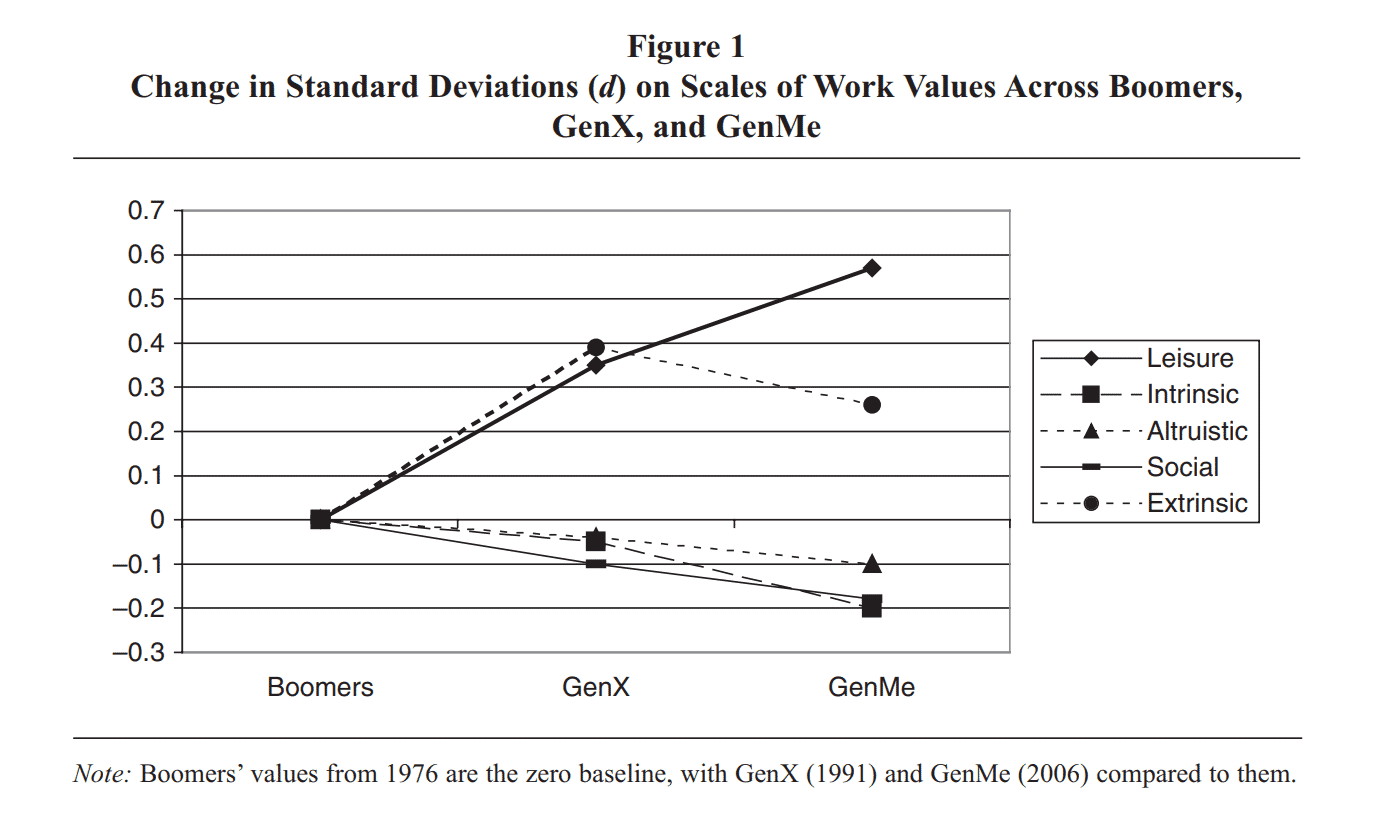
The central finding is that generational differences exist but are small in magnitude. In many cases, differences are statistically detectable but not practically large. Changes in economic and social context explained most of the variation.
Some detailed conclusions include:
-
Work centrality (importance of work in life) has slightly declined over generations
-
Desire for leisure time has slightly increased
-
Extrinsic values (money, status, promotions) increased modestly over time
-
Intrinsic values (meaningful work, helping others) remained relatively stable
-
Organizational commitment and job satisfaction did not show large generational declines
-
Self-esteem and narcissism increased slightly but not to “epidemic” levels claimed in media
The authors emphasize that age differences often mimic “generational” claims:
-
Younger workers have always cared somewhat more about advancement and rewards
-
Older workers have always reported higher stability and commitment
-
This has been true across decades, not unique to Millennials
Implications for managers and organizations
Research shows that understanding employee values isn’t just HR theory—it’s a powerful tool for attracting and retaining talent. Generational differences matter, especially with GenX and GenMe workers entering the workforce. Studies indicate these younger workers prioritize leisure and work-life balance far more than Boomers did at the same age, and this shift has serious implications for companies looking to stay competitive.
Why it matters: Traditional perks and intrinsic motivators like meaningful work, career growth, or environmental impact may not drive GenMe engagement as much as we think. While all generations value intrinsic rewards, GenMe actually puts slightly less emphasis on them than Boomers did, meaning companies need to rethink their retention strategies.
Actionable Insights for Companies:
-
Redesign Work for Leisure, Not Just Hours
-
Interventions like compressed work weeks (40 hours in 4 days) and flextime (choose your own start and stop times) are proven to boost motivation, satisfaction, and commitment.
-
These policies shouldn’t just target parents—GenMe wants time off for travel, hobbies, or social life, not just family care.
-
-
Incorporate Leisure into Rewards Systems
-
During budget crunches, offering additional vacation days or personal time can be a highly valued and cost-effective reward.
-
Example: Google provides “balance enhancers” like flexible hours, free laundry, dog-friendly offices, and on-site medical care—ensuring employees gain more leisure without sacrificing work productivity.
-
-
Leisure Boosts Productivity Too
-
U.S. workers log long hours, yet burnout, absenteeism, and health costs rise. By offering more leisure, companies could actually increase efficiency and profitability, following lessons from more efficient global labor markets.
-
-
Rethink Social and Altruistic Rewards
-
Contrary to popular belief, GenMe does not prioritize social or altruistic rewards more than previous generations. Paying employees to volunteer or emphasizing societal impact is still motivating, but it’s not uniquely appealing to GenMe.
-
Team-centered cultures aimed at attracting younger workers may miss the mark, as GenMe places less importance on organizational social bonds, partly due to boundaryless careers and digital social networks.
-
-
Address Generational Fit
-
Many organizations are led by Boomers, whose values may differ from GenMe’s. Misalignment can cause lower engagement, performance, and retention. Companies need strategies to assimilate younger workers without forcing them to conform to outdated norms.
-
-
Don’t Fall for Stereotypes
-
Research confirms that assumptions about younger workers being overly altruistic or older workers underperforming are largely false. The real differences exist within generations more than between them, so policies should focus on flexible, value-driven approaches.
-