Creativity in teams
What personality, team dynamics, and gender really tell us
Date: 20. April 2026
Categories: Performance, Diversity, Future Skills

Creativity sits at the heart of innovation, transformation, and competitive advantage. Yet many organizations still rely on intuition—or stereotypes—when trying to identify or develop creative talent.
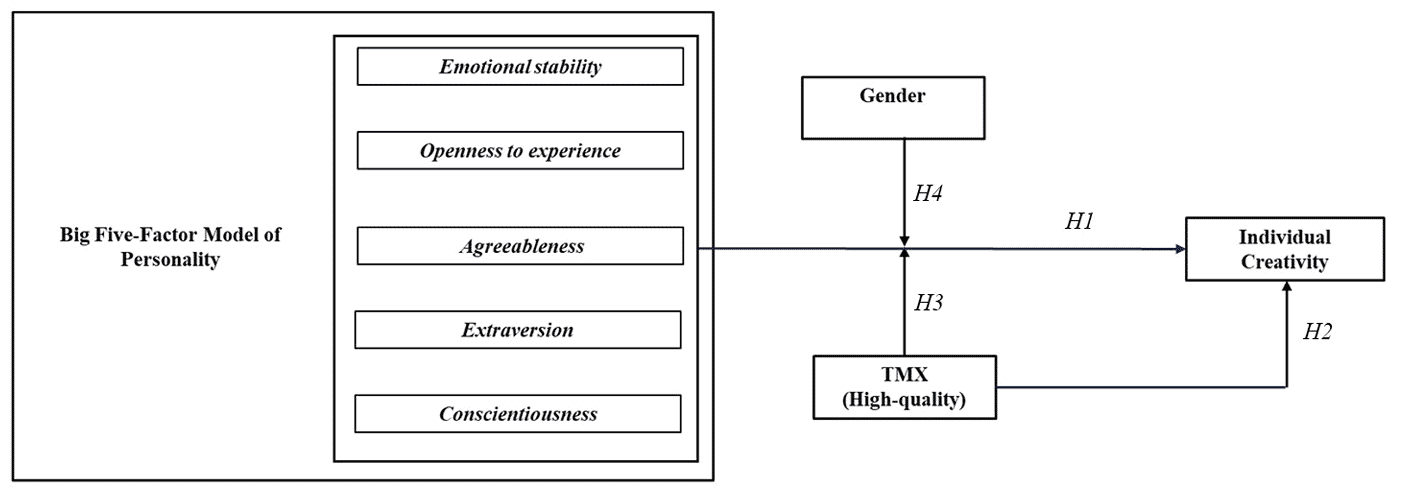
A recent study by Pérez-Luño, Aguilar-Caro, and Muñoz-Doyague (N = 639 participants, ~52% women) provides a more evidence-based answer by examining how:
- Personality traits
- Team relationships (TMX)
- Gender
interact to shape creativity in individuals.
What makes it particularly valuable is that it doesn’t look at these factors in isolation but as a system.
1. What the researchers were trying to assess
The study was built around three key objectives:
A. Understand which personality traits drive creativity
Using the Big Five model, the researchers tested whether each trait contributes to generating novel and useful ideas.
B. Examine the role of team relationships (TMX)
TMX reflects:
- Trust between colleagues
- Willingness to share ideas
- Mutual support
In other words: the social “oxygen” of creativity
C. Explore whether gender changes these relationships
Rather than comparing raw creativity levels, the study asked: Do men and women activate their creativity differently, depending on personality and team context?
2. Key findings
2.1 Personality: creativity is multi-dimensional
Four personality traits significantly predict creativity:
- Openness to experience (strongest driver)
- Curiosity, imagination, willingness to explore
- Extraversion
- Energy, social engagement, idea sharing
- Agreeableness
- Collaboration, trust, knowledge exchange
- Conscientiousness
- Discipline, persistence, execution of ideas
Emotional stability shows a more complex, context-dependent effect.
Important shift for practitioners:
Creativity is not just about “creative thinkers”, it’s also about social and execution capabilities.
2.2 Team-member exchange (TMX): the hidden multiplier
TMX has a strong direct impact on creativity (β ≈ 0.18–0.21).
But more importantly, it acts as a multiplier:
- High TMX → strengthens personality effects
- Low TMX → weakens or even blocks them
Example from the study:
- Extraversion + high TMX → strong increase in creativity
- Extraversion + low TMX → much weaker effect
Translation for organizations:
- You don’t “unlock creativity” through hiring alone
- You unlock it through team quality
2.3 Gender: no difference in creativity—but important differences in HOW it emerges
This is the most nuanced—and often misunderstood—part of the study.
First, the headline result:
- No significant difference in overall creativity between men and women
This directly challenges the long-standing stereotype that creativity is more “male.”
But the deeper insight is more subtle:
Gender moderates how personality traits translate into creativity
In other words:
- Men and women are equally creative overall
- But they leverage different traits differently
A. Extraversion × Gender
The study finds a crossover effect:
- High extraversion:
- Women become more creative than men
- Low extraversion:
- Men become more creative than women
Interpretation:
- For women, social energy and visibility amplify creativity strongly
- For men, creativity is less dependent on being socially expressive
Implication for HR / coaching:
- Encourage extraversion differently:
- For women → amplify expression, voice, visibility
- For men → don’t assume low extraversion = low creativity
B. Emotional Stability × Gender
Another inversion effect appears:
- Low emotional stability (higher sensitivity):
- Women are more creative than men
- High emotional stability:
- Men are more creative than women
Interpretation:
- Emotional intensity or sensitivity may fuel creativity more strongly in women
- Stability and calmness may support structured creativity in men
This is particularly important because:
- Emotional instability is often seen as a “risk”
- The study shows it can also be a creative asset, especially for women
C. Openness × TMX × Gender (most complex finding)
This is a three-way interaction, and it’s critical for understanding team dynamics.
For women:
- Openness to experience → increases creativity at all levels of TMX
- They benefit consistently from being curious and exploratory
For men:
- Openness increases creativity mainly when TMX is low
- When TMX is high, the effect is less pronounced
Interpretation:
- Women convert openness into creativity regardless of environment
- Men rely more on context (team dynamics) to activate openness
Simplified takeaway
- Creativity ≠ gender
- But:
- Women’s creativity is more consistently expressed across contexts
- Men’s creativity is more context-dependent
For organizations:
- Don’t evaluate creativity in a “one-size-fits-all” way
- Context + personality + gender interactions matter
3. Practical implications for HR, consultants, and coaches
3.1 Move beyond “creative personality” stereotypes
Instead of focusing only on:
- “Innovative thinkers”
- “High openness”
Consider a broader profile:
- Social collaboration (agreeableness)
- Execution discipline (conscientiousness)
- Energy and engagement (extraversion)
3.2 Build teams—not just talent
Since TMX is a key driver:
Focus on:
- Psychological safety
- Trust and reciprocity
- Knowledge sharing
Practical levers:
- Team coaching
- Feedback culture
- Cross-functional collaboration
3.3 Use gender insights without stereotyping
The study supports a balanced but nuanced view:
Avoid:
- “Men are more creative”
- “Women are more collaborative”
Instead:
- Understand different pathways to creativity
3.4 Coaching applications
For individual development:
- Help people understand:
- Their creative drivers (personality)
- Their context dependencies (team)
- Tailor coaching:
- Extraverts → leverage networks
- Introverts → build safe idea spaces
- Emotionally sensitive individuals → channel into ideation