CRF 2026 - Four Insights for the Future of HR
What makes CRF unique is its ambition to elevate HR beyond its traditional support function and position it as a true strategic driver of organizational success.
Date: 17. June 2026
Categories: PGarticle
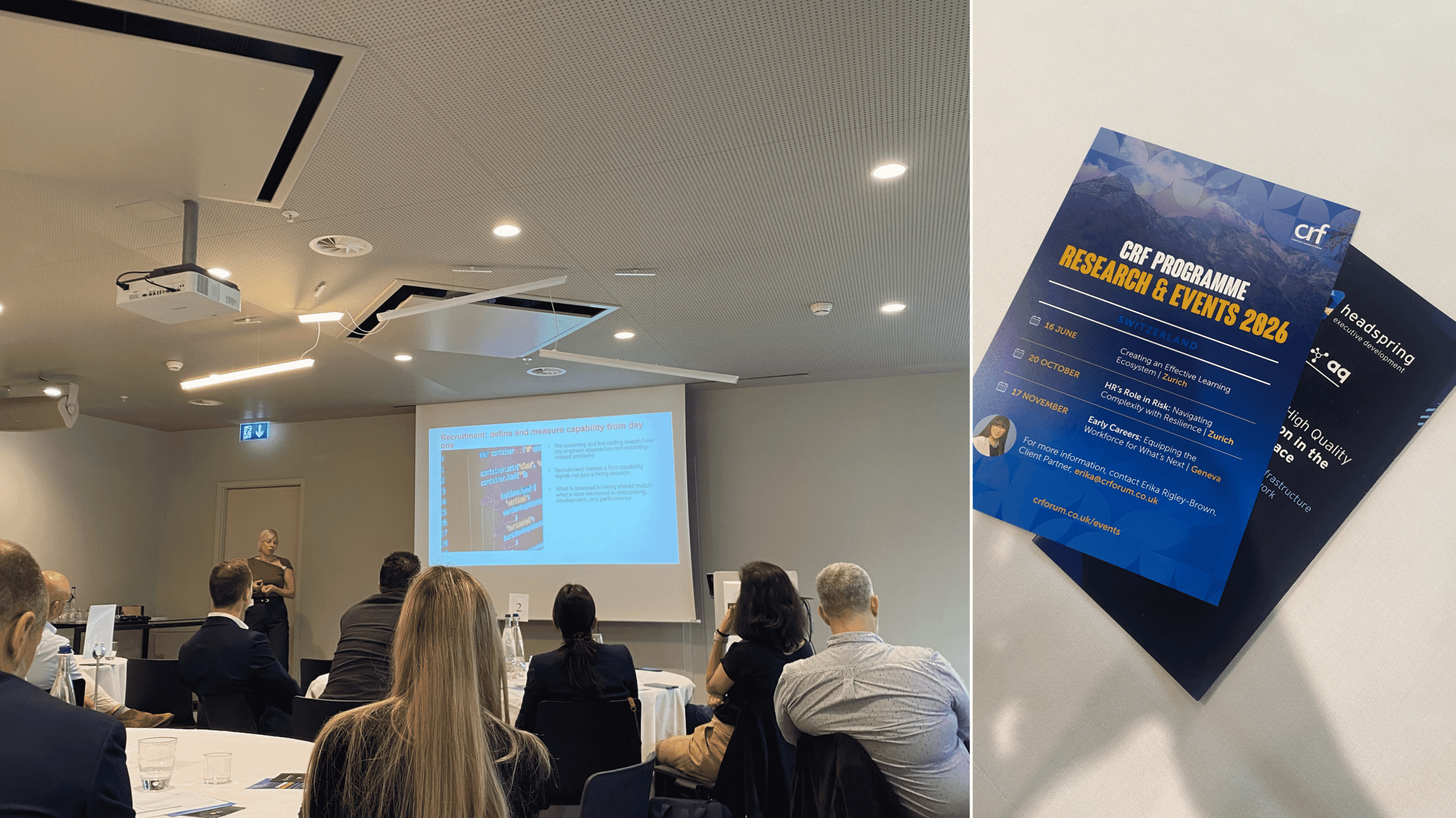
Our team had the opportunity to attend the CRF Learning Ecosystem event, bringing together HR professionals, business leaders, researchers, and experts from a wide range of industries.
What makes CRF unique is its ambition to elevate HR beyond its traditional support function and position it as a true strategic driver of organizational success. Through inspiring speakers, practical case studies, and thought-provoking discussions, the event explored one key question: How can HR help organizations thrive in a world that is becoming increasingly complex?
Below are four insights that particularly resonated with us.
1. In Times of Polycrisis, People Need Hope
The term polycrisis was mentioned repeatedly throughout the event.
Organizations today are not dealing with a single challenge. They are facing multiple crises simultaneously: economic uncertainty, geopolitical tensions, talent shortages, technological disruption, climate concerns, and growing mental health challenges. In such an environment, leaders often focus on solving problems. Yet one speaker reminded us that before people can perform, innovate, or adapt, they need something more fundamental:
Hope.
Hope is not optimism. Hope is the belief that the future can be better and that we can actively contribute to making it happen.
Research from the Center for Creative Leadership highlighted that hope is driven by action. When people feel they can move forward, influence outcomes, and make progress, hope increases. When action is blocked, hope declines.
What prevents action?
Common barriers include:
- Maintaining the status quo
- Fear of failure
- Lack of clarity
- Excessive bureaucracy
- Organizational silos
- Low psychological safety
The challenge for leaders is therefore not only to solve problems but also to identify and remove the barriers that prevent people from taking action.
Because when action becomes possible, hope follows.
And when hope increases, engagement often follows as well.
2. Stop Thinking in HR Processes. Start Thinking in Systems.
One of the most powerful ideas discussed at the event was surprisingly simple.
Many HR functions are still organized into separate areas:
- Recruitment
- Onboarding
- Learning
- Performance Management
- Talent Management
- Leadership Development
Each process often operates efficiently on its own. But employees do not experience HR in separate departments. They experience one journey.
Rather than asking:
“What should we add?”
Organizations should ask:
“What should we connect?”
What if onboarding informed development plans? What if performance conversations connected directly to learning opportunities? What if recruitment data helped shape succession planning? The future of HR is not necessarily about creating more initiatives rather about creating stronger connections between existing ones. The most effective learning ecosystems are not collections of programs. They are interconnected systems.
3. AI Is Changing the Skills That Matter
Artificial Intelligence was naturally one of the central topics of the event. While technology continues to evolve at an extraordinary pace, many speakers agreed on one important point:
The skills that will matter most in the future are increasingly human.
Among the capabilities highlighted were:
- Data literacy and analytical thinking
- Creativity and innovation
- Effective communication
- Giving and receiving feedback
- Adaptability
- Systems thinking
- Collaboration across disciplines
Ironically, as technology becomes more powerful, the uniquely human skills become even more valuable. The organizations that succeed will not be those that simply adopt AI faster than others. They will be those that develop the human capabilities needed to work alongside it.
4. AI Adoption Starts with Psychological Safety
One of the most memorable sessions came from a speaker from IE University, who challenged a common assumption about AI implementation. Many organizations invest heavily in technology, platforms, and training. Yet adoption remains low.
Why? Because implementation is not only a technology challenge. It is a human challenge.
You can introduce the most advanced AI tools available. But if employees are afraid of making mistakes, fear being replaced, or do not understand how AI will affect their work, adoption will remain limited. The session emphasized the importance of psychological safety when introducing AI into any learning ecosystem. People need to feel safe to:
- Experiment
- Learn
- Ask questions
- Make mistakes
- Share concerns
Before asking, “How do we implement AI?” organizations should ask: “What barriers prevent our people from embracing it?”
The exercise presented during the session provided a practical framework to identify these barriers and create targeted actions to address them. If you would like to learn more about this exercise, feel free to get in touch with us!
Your PG Guides